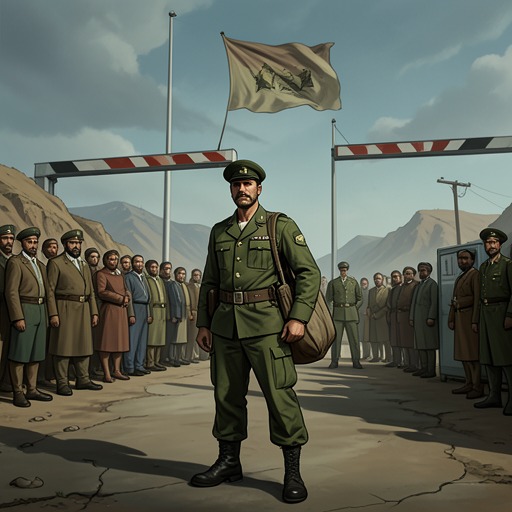
Mauritanian Independence Day
Guantanamo DiaryMauritanian Independence Day, November 28, is both a national anniversary and the date on which Mohamedou Ould Slahi says Mauritania transferred him to Jordan in 2001. The coincidence gives the holiday a sharp narrative irony: a day commemorating the country’s independence becomes the occasion for the transfer of one of its own citizens under an arrangement involving Mauritania, the United States, and Jordan.
Anniversary and remembered parade
The date marks Mauritania’s independence from French colonial rule in 1960. The night before the transfer agreement was finalized, guards allowed Slahi to watch a parade moving from downtown toward the Presidential Palace of Mauritania. Bands accompanied schoolboys carrying lighted candles. The procession recalled his own participation as a schoolboy nineteen years earlier, when he had regarded the anniversary as a celebration of the country’s birth without yet considering what sovereignty required.
That memory gives the holiday more than a ceremonial role. Slahi contrasts his childhood understanding of national independence with his later judgment that a country cannot be fully sovereign if it cannot handle its own affairs. The parade remains a public display of national identity, but the events around it make that display sit uneasily beside the government’s dependence on an international security arrangement.
November 28, 2001
Slahi writes that he spent seven days in Mauritanian custody, without a family visit; he later learned that his family had not been allowed to see him or told where he was. On the eighth day, November 28, he was informed that he would be sent to Jordan. He was seriously ill during this period, and the prospect of the transfer followed a stretch in which he had been unable to eat normally and had required medical attention.
The narrative explicitly links the transfer to the anniversary. Slahi describes Mauritania as handing over a citizen on the very day it marked its independence, and argues that this contradicted the constitutional bar on extraditing Mauritanian citizens. His account presents the transfer not simply as a change of location but as a breach of the protections and self-determination the holiday commemorated.
Ceremony beside detention
The contrast continued on the holiday itself. The head of the Mauritanian State Security Directorate came to see Slahi despite the public celebration; the official had been invited to the ceremonial colors at the Presidential Palace of Mauritania. He arrived with an assistant and a recorder for an interrogation. The guards were sent home, and they left believing Slahi might be released. Slahi, however, remained skeptical of the activity around him.
In this sequence, the parade and the interrogation belong to the same national occasion but point in opposite directions. The anniversary gathers people around a public memory of independence; Slahi’s impending transfer shows how little control he says the state exercised over his fate. The date thus binds personal recollection, national ceremony, and political contradiction into one recurring measure of sovereignty.